
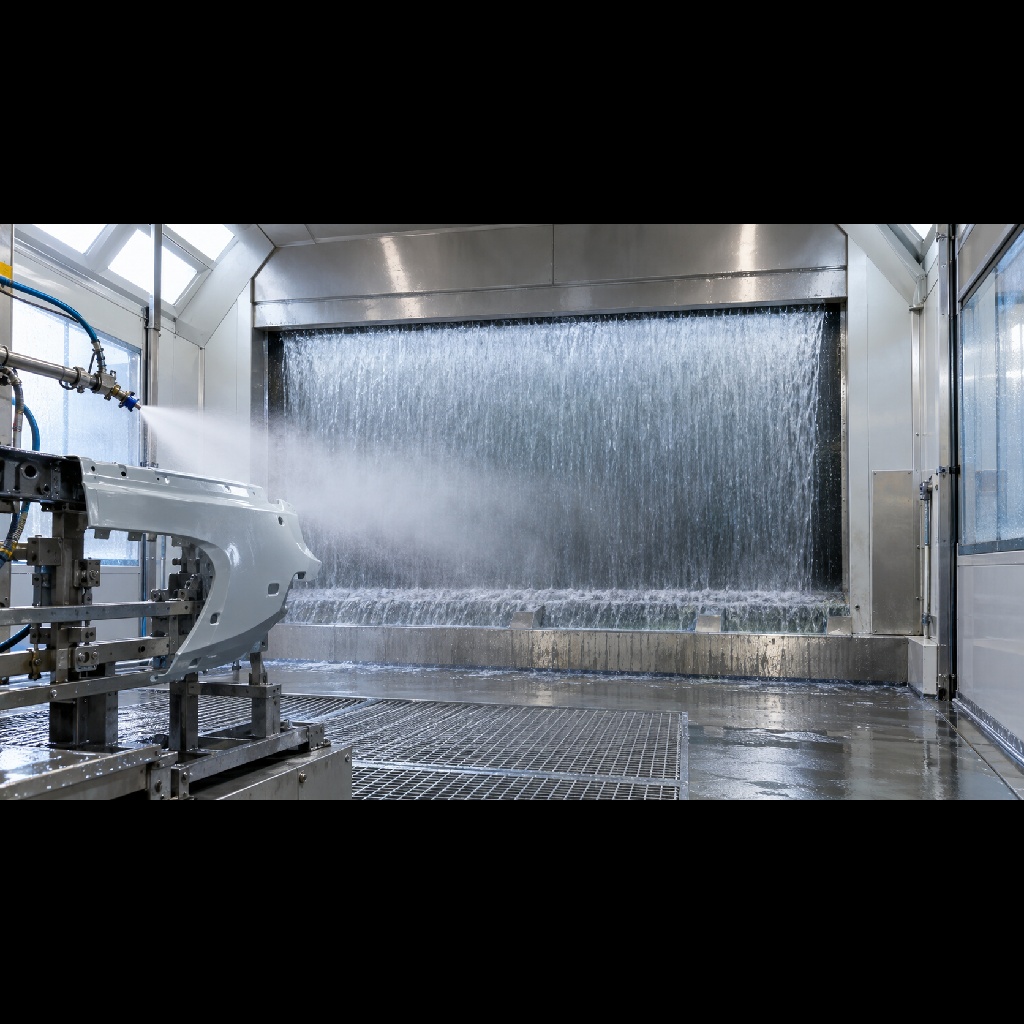
A spray booth can seem well matched to a job at the start of a shift, then struggle as overspray builds up through repeated coats. In high-volume spray finishing, that change matters: extraction must keep moving contaminated air away from the work while production continues. Water curtain performance is therefore about sustained overspray capture, dependable airflow, and a maintenance routine that fits the workload.
In a water wash spray booth, extraction draws paint-laden air towards a flowing sheet of water. Overspray particles are caught in the water and collected for removal, rather than accumulating solely in disposable filter media. The curtain is part of the capture system; it does not replace the need for a booth layout and extraction system suited to the spraying process.
For operators, the benefit is most relevant during continuous work. Dry filters can load quickly when large amounts of coating are sprayed, increasing resistance to airflow and prompting more frequent changes. A water curtain can help the booth maintain extraction performance over longer production runs, provided the water system and the rest of the booth are maintained properly.
The condition of the curtain matters as much as its presence. Water needs to flow across the intended capture area without gaps or an uneven pattern. If flow is interrupted, overspray may pass through areas where capture is less effective. Booth design, spray position, and the path air takes across the work all influence the result.
A water curtain does not automatically improve every finish. Its value lies in supporting a controlled spraying environment when the booth is used repeatedly. Extraction helps carry airborne overspray away from the freshly coated surface and the operator’s working area. If airflow changes substantially during a run, the spraying conditions change too, even when the coating and application method stay the same.
Consider a workshop coating a succession of fabricated panels. With each panel, more paint reaches the capture system. If its dry filters need frequent replacement, the team must either schedule those changes or risk working with increasingly loaded media. A suitably designed water wash booth offers another way to handle that workload. The useful question is not which booth sounds more powerful, but how each system performs across the workshop’s actual shift pattern.
Component size also affects the choice. A large or awkward part may change where the operator stands and how the spray plume travels. The booth must have enough working space and an airflow arrangement that draws overspray away from the coating area. A wide water curtain will offer limited benefit if the part blocks the intended air path or spraying takes place outside the effective capture zone.
The visible sheet of water depends on pumps, pipework and nozzles supplying a steady flow. Restricted nozzles or a poorly maintained water circuit can affect its coverage. These details deserve attention when comparing booths for continuous use, alongside the extraction and the size of the working area.
One water wash spray booth, for example, is specified with a 1.6-metre water curtain over a stainless steel screen. Its large-bore nozzles and high-capacity pumps are intended to support constant flow, while ABS pipework avoids corrosion in the water circuit. Those features describe how the booth is built; performance in a particular facility still depends on the chosen configuration, installation and upkeep.
A made-to-order booth can be planned around a single spray station or a larger line. Before specifying one, it helps to establish what is being coated, how often, and where parts enter, turn and leave the spraying area. Those practical details shape the booth dimensions and capture arrangement more meaningfully than production volume alone.
Capturing overspray in water changes the maintenance task; it does not remove it. Paint residues collect in the system and need managing, along with the water and associated waste. Operators also need to watch for changes in curtain coverage, unusual flow patterns, and signs that the spray nozzles or water circuit need attention.
A useful maintenance plan should account for:
On some water wash booths, isolation valves allow maintenance without draining the tank. That can simplify planned work, although the need for cleaning, inspection and appropriate waste handling remains. A documented maintenance programme also gives operators a clear basis for routine checks.
For more detailed information on this topic, read our guide on How Spray Booth Lighting Improves Paint Finish Quality.
Water wash is most compelling where spraying is frequent enough to load dry filters quickly. It can suit manufacturing lines, industrial coating plants and busy workshops that need consistent capture throughout long runs. For lighter or intermittent spraying, a dry filter booth may be simpler and cost less to operate. The decision should reflect real usage, including coating volume, shift length, component dimensions, and available maintenance resources.
For example, a business spraying a few parts on occasional days may gain little from a water system that still needs care between jobs. A line coating parts continuously faces a different problem: interruptions for filter changes can become part of the daily schedule. Comparing those operating patterns is more useful than choosing by booth type alone.
A water curtain performs best when its flow, extraction, and working layout are designed as one system. Evaluate how the booth will behave late in a production run, how staff will maintain it, and whether it fits the parts being coated. Those questions turn a general filtration choice into a practical finishing decision.
We provide reliable spray booth installation, repair, and maintenance services designed to improve performance, safety, and efficiency. Our experienced team delivers quality solutions tailored to industrial and commercial needs.